How Local and Regional Vacation Rental Managers Can Compete with the Giants
Why small and mid-sized companies do not need to
become national brands to win. But they do need to become more strategic.
The short-term rental industry is changing.
National operators are growing.
Management companies are consolidating.
Software platforms are becoming more powerful.
OTAs continue to shape guest behavior.
Regulation is increasing.
Owners are asking harder questions.
Guests expect more.
And local and regional vacation rental managers are being forced to decide what kind of company they want to become.
For many smaller and mid-sized managers, the pressure is real.
Large companies may have more capital, bigger marketing budgets, stronger technology, more data, larger teams, national brand recognition, and deeper acquisition resources.
That can feel intimidating.
But smaller and regional companies still have advantages the giants often struggle to replicate.
They know the local market.
They know the owners.
They know the homes.
They know the neighborhoods.
They know the vendors.
They know the local events, seasons, demand drivers, and guest expectations.
They understand the destination in a way a national call center or centralized team often cannot.
That local connection still matters.
But local connection alone is no longer enough.
The companies that win the next phase of the short-term rental industry will not be the ones that simply say, “We’re local.”
They will be the ones that combine local expertise with professional systems.
That is where small and mid-sized vacation rental managers can still compete.
Not by becoming the giants.
But by becoming better positioned, better aligned, and more strategic.
The Giants Have Real Advantages
Local managers should not underestimate large national operators.
They have advantages.
They often have more capital.
They can invest more heavily in technology.
They can recruit specialized employees.
They can build larger marketing teams.
They may have stronger direct booking infrastructure.
They may have more sophisticated reporting.
They may have access to more data.
They can acquire companies, portfolios, and market share.
Those advantages matter.
It would be a mistake to pretend they do not.
But large companies also have challenges.
As companies grow, they can become more centralized.
Decision-making can move farther away from the property.
Owner relationships can become more transactional.
Guest service can become more standardized.
Employees can feel less connected to the mission.
Local nuance can get lost.
The company can become focused more on scale than service.
That creates an opening for local and regional managers.
But only if they are ready to compete at a higher level.
Local Is an Advantage, If You Turn It into Strategy
Being local is powerful.
But only if it shows up in the business.
It cannot just be a slogan.
A local company has to use its local advantage in ways that owners and guests can actually feel.
That means better destination knowledge.
Better local content.
Better vendor relationships.
Better owner communication.
Better guest recommendations.
Better understanding of neighborhood concerns.
Better relationships with HOAs and city leaders.
Better market-specific revenue strategy.
Better property positioning.
Better ability to explain why one home performs differently than another.
Better ability to connect a guest’s reason for travel to the right property, the right message, and the right follow-up.
That is how local becomes a competitive advantage.
The question is not whether a company is local.
The question is whether the company is using local knowledge to create better results.
Small Managers Cannot Stay Underbuilt
One of the biggest risks for local and regional managers is assuming that personal service is enough.
It is not.
Owners want personal service, but they also want performance.
Guests want local recommendations, but they also expect smooth systems.
Cities and HOAs may appreciate local accountability, but they still expect professionalism.
A smaller company cannot compete with national operators if it is underbuilt.
That means a local manager cannot rely only on referrals, repeat owners, OTA bookings, or a good reputation from five years ago.
The industry is too competitive now.
A local or regional manager needs:
That does not mean every company needs to become large.
It means every company needs to become intentional.
Competing With Giants Requires a Full Spectrum Approach
The mistake many companies make is trying to solve growth one piece at a time.
They try to improve pricing without improving marketing.
They try to build direct bookings without building a guest database.
They post on social media without connecting it to SEO, email, or guest intent.
They chase new owners without proving how their strategy creates value.
They complain about OTAs but do not build their own guest relationships.
They say they are local but do not turn local knowledge into content, authority, or owner trust.
That is why growth stalls.
The pieces are disconnected.
A stronger approach connects the entire system.
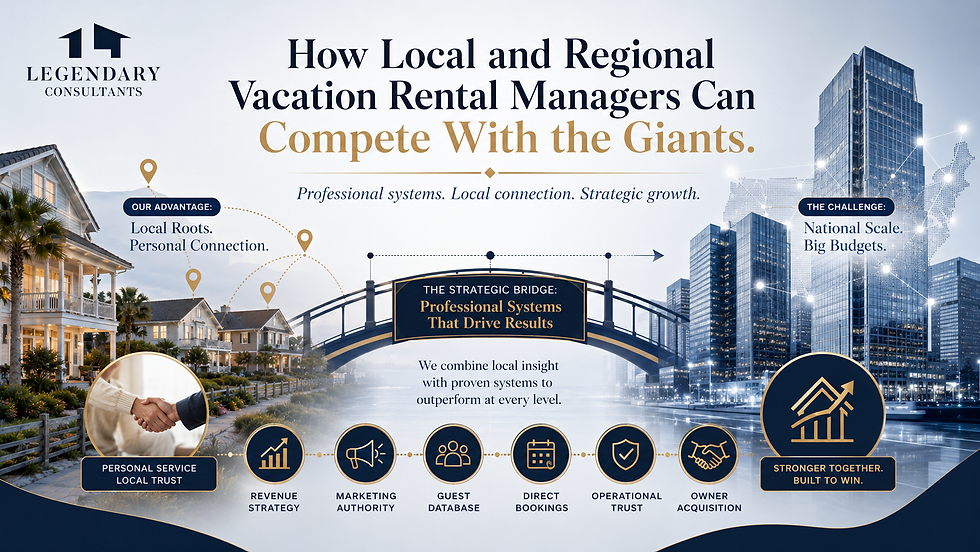
At Legendary RE Consultants, we call this the Full Spectrum Approach.
It connects the major areas that drive long-term vacation rental growth:
Revenue Strategy
Marketing Authority
Guest Database & Direct Booking Strategy
Operational Trust
Owner Acquisition
Long-Term Value
When those pieces work together, a company becomes much more competitive.
Not because it is bigger.
Because it is more aligned.
1. Revenue Strategy: Compete with Better Market Understanding
Revenue management is not just changing rates.
It is understanding demand.
A local or regional manager should be able to explain what drives bookings in their market.
Not just seasonality.
Demand.
Why do guests come?
When do they book?
What events move the market?
Which properties attract families?
Which attract pet travelers?
Which perform better for long stays?
Which need weekend strategy?
Which need event pricing?
Which need shoulder-season positioning?
This is where local managers can beat the giants.
A national company may have data.
But a local company should have context.
The best revenue strategy combines both.
Data tells you what is happening.
Local knowledge helps explain why.
That combination is powerful.
Owners do not just want someone pushing buttons in pricing software.
They want someone who understands their property, their market, and their goals.
2. Marketing Authority: Become the Local Expert
Large companies often have stronger domain authority and bigger marketing budgets.
But local companies should have stronger local authority.
That means their websites, blogs, social media, email campaigns, and owner materials should prove they understand the market better than anyone else.
This is where many smaller managers miss the opportunity.
Their strategy has to be different than the giants.
Going head-to-head with the giants using their same strategy is a recipe for failure.
You can't beat them at their game, on their terms.
Small managers websites are often built only around properties.
But guests do not search only for properties.
They search for properties once they have decided on where they want to go, why they want to go there, and when they plan to go there.
And small managers can't compete with the giants head-to-head on search engines once they get to this point and end up relying on OTA's to book their properties.
Guests search for reasons to travel first. Before ever searching for a property.
Pet-friendly trips.
Family vacations.
Beach weekends.
Golf trips.
Fishing trips.
Spring training.
Ski season.
Festivals.
Weddings.
Bachelorette weekends.
Winter escapes.
Remote work stays.
Multi-generational trips.
Those Reasons for Travel should become part of the marketing strategy. They should be the CORE to your guest strategy.
They should drive blog content, SEO, social media, email campaigns, guest segmentation, direct booking strategy, and owner acquisition.
This is where local managers can shine.
They know the restaurants.
They know the beach accesses.
They know the event calendar.
They know the hidden gems.
They know the neighborhoods.
They know where the dog parks are.
They know the best patios to enjoy the sunset while having dinner.
They know which hiking trails to take in the summer, the winter.
They know how their town looks covered with snow, and with no snow, and what to do during both times.
They know what guests ask before they book.
That knowledge should not stay trapped in phone calls and guest messages.
It should become content.
It should become authority.
It should become part of the brand.
Why keep your most valuable asset locked away only to be opened with a direct message or phone call asking for that information when you could share it up front, before guests get in front of the giants and the OTA's? Before the giants and the OTA's even know the guest is looking.
3. Guest Database: Own the Relationship
One of the biggest advantages large companies have is the ability to build and use guest data.
But local managers can do this too.
They just have to stop treating the guest database like an afterthought.
A booking history is not the same thing as a guest database.
A true guest database helps a manager understand:
Who stayed
Why they traveled
What type of property they booked
Whether they brought pets, kids, friends, or extended family
What season or event brought them to town
Whether they are likely to return
What message should be sent to them next
That database becomes the engine behind repeat bookings, direct bookings, email marketing, retargeting, guest loyalty, and owner value.
OTAs may introduce the guest.
But if the OTA owns the relationship forever, the manager is still dependent.
Local and regional managers should be building guest relationships from the first booking.
That is one of the most important ways to compete long-term.
Every first stay from an OTA is an opportunity for your next repeat booking.
4. Direct Booking Strategy: Reduce Dependency Without Abandoning OTAs
OTAs are not the enemy.
They can be powerful booking channels.
But they should not be the entire strategy.
And how you use them and look at them should change.
A local company that depends almost entirely on OTAs is vulnerable.
Platform rules can change.
Cancellation policies can change.
Search visibility can change.
Fees can change.
Guest communication can be limited.
Competition can increase overnight.
Direct booking strategy gives a manager more control.
It does not mean abandoning Airbnb, Vrbo, or other platforms.
It means using them as channels, as initial lead sources, not allowing them to own the entire business or the guest relationship. You're more than just the booking agent for VRBO or Airbnb.
You're the company owner. The manager. These are YOUR guests, not the OTA's guests. Build the relationship and own the guest.
Direct booking growth comes from several connected pieces:
A strong website.
SEO content.
Guest database strategy.
Email marketing.
Repeat guest campaigns.
Social media.
Retargeting.
Reasons for Travel content.
Brand trust.
Owner confidence.
This is another area where the Full Spectrum approach matters.
Direct bookings do not grow because a company adds a “Book Direct” button.
They grow because the company builds a system that gives guests a reason to come back.
5. Operational Trust: Win Where Giants Feel Distant
Operational trust may be one of the biggest advantages local companies have.
Owners want to know what is happening with their property.
They want transparency.
They want communication.
They want to know repairs are handled properly.
They want to know pricing decisions make sense.
They want to know guest issues are addressed.
They want to know the company is not hiding fees, marking up maintenance unfairly, or treating them like just another account.
This is where smaller managers can outperform larger competitors.
But only if the trust is supported by systems.
Trust should not rely only on friendliness.
It should be built through:
Clear reporting.
Transparent fees.
Owner portals.
Regular communication.
Maintenance accountability.
Vendor management.
Documented processes.
Proactive revenue conversations.
Clear guest standards.
Fast issue response.
A local manager who combines personal communication with professional transparency can build a level of owner trust that is hard for a distant national company to match.
6. Owner Acquisition: Stop Relying Only on Referrals
Many local and regional managers grow through referrals.
That is good.
But it is not enough.
Referrals are valuable, but they are not a complete owner acquisition system.
A company that wants to compete with larger operators needs to be visible before the owner is ready to switch.
That means creating authority before the sales conversation.
Owner acquisition should be supported by:
Owner-focused website pages
Market reports
Revenue strategy content
Investor education
Broker partnerships
Case studies
Owner email campaigns
Social proof
Local market insights
Clear differentiation
A strong explanation of the company’s management philosophy
The best owner acquisition strategy does not simply ask owners to sign up.
It shows them why the company thinks differently.
That is especially important for smaller managers competing with national brands.
The local manager must be able to answer:
Why should an owner choose us instead of a larger company?
The answer cannot simply be, “We are local.”
The answer should be:
Because we know this market better.
Because we communicate more clearly.
Because we protect your property.
Because we build guest relationships.
Because we understand demand.
Because we are part of the community.
Because we have professional systems without losing personal service.
That is a much stronger position, but you have to be able to back up the words with real action and proof.
7. Long-Term Value: Think Beyond the Booking
Vacation rental management companies should not think only in terms of nightly rates and occupancy.
They should think in terms of long-term owner value.
A strong manager can help owners understand:
When to improve a property
Which amenities matter
How positioning affects revenue
How regulations may affect investment decisions
How guest feedback should guide upgrades
How direct booking strategy affects long-term value
When a property may need repositioning
When an owner may be ready to buy, sell, exchange, or expand
This is where local and regional companies can become more than managers.
They can become strategic advisors.
That matters because owners do not just need someone to manage bookings.
They need someone who understands the asset.
They need someone who understands the market.
They need someone who can help them make better long-term decisions.
That is a major opportunity for companies that combine property management, revenue strategy, real estate knowledge, and local expertise.
Small and mid-sized vacation rental companies do not need to become national giants to compete with them. But they must become more strategic, more professional, and utilize their local knowledge and tools more effectively.
Fractional Support Can Help Smaller Companies Compete Faster
One of the challenges for small and mid-sized managers is that they need big-company capabilities before they can afford big-company payroll.
They may need revenue management, marketing strategy, SEO, social media, email campaigns, guest database strategy, direct booking support, and owner acquisition systems.
But they may not be ready to hire full-time specialists for every role.
That is where fractional support can make sense.
A company may not need a full-time revenue manager yet.
It may not need a full-time marketing manager yet.
It may not need an entire internal strategy team yet.
But it may need those functions.
Fractional support can help bridge the gap.
It gives a local or regional manager access to professional strategy and execution without forcing the company to add permanent overhead before the revenue supports it.
That flexibility matters even more in a changing market.
The goal is not to avoid hiring forever.
The goal is to build the right systems first.
Then, when the company is ready, internal hires can step into a stronger foundation.
The Goal Is Not to Outspend the Giants
Small and mid-sized vacation rental companies will not usually outspend national operators.
They do not need to.
They need to out-position them.
They need to out-serve them.
They need to out-connect them locally.
They need to be more trusted by owners.
They need to be more useful to guests.
They need to be more connected to the community.
They need to be more intentional with revenue, marketing, operations, guest relationships, and owner acquisition.
That is how they compete.
Not by pretending the giants do not have advantages.
Not by refusing to professionalize.
Not by relying only on being local.
But by combining the best parts of local management with the systems needed to compete in a more sophisticated industry.
Local and Professional Is the Winning Combination
The future does not belong only to the biggest companies.
It belongs to the companies that create the most trust, the clearest value, and the strongest connection to their markets.
For local and regional managers, the opportunity is still there.
But the standard is higher now.
Owners expect more.
Guests expect more.
Cities and HOAs expect more.
The market demands more.
The competition is more sophisticated.
Local managers cannot stay casual.
But they also should not lose what makes them different.
The best path forward is not to become a smaller version of a national giant.
The best path is to become a more professional version of a local expert.
That means:
Better systems.
Better strategy.
Better marketing.
Better revenue management.
Better owner communication.
Better guest relationships.
Better direct booking strategy.
Better local authority.
Better operational trust.
That is how small and mid-sized vacation rental managers can compete.
They do not have to become national giants.
They have to become strategically local.
That is the opportunity.
You have to stop and ask yourself,
"What do we know that the giants don't"
"What can we do that they can't"
"How does that affect our owners and guests"
"How can that best be utilized as a strategic tool.
And for the companies willing to build the systems, strengthen the relationships, and connect the full spectrum of their business, the future is still very much within reach.
Series Note
This article is Part 3 of a three-part series on the future of the short-term rental industry.
Part 1 explored why the industry needs fair regulation and balance instead of bans or free-for-alls.
Part 3 focuses on how local and regional vacation rental managers can compete with national giants by becoming more professional without losing what makes them local.
Legendary RE Consultants helps vacation rental managers build stronger revenue, marketing, guest database, owner acquisition, and direct booking systems through a Full Spectrum Approach.
If your company is trying to compete in a changing market, request a Full Spectrum Growth Assessment to identify where your strategy is strong, where the gaps are, and what systems need to be built next.