
The Short-Term Rental Industry Needs Balance — Not Bans or Free-for-Alls
A practical path for cities, HOAs, owners, managers,
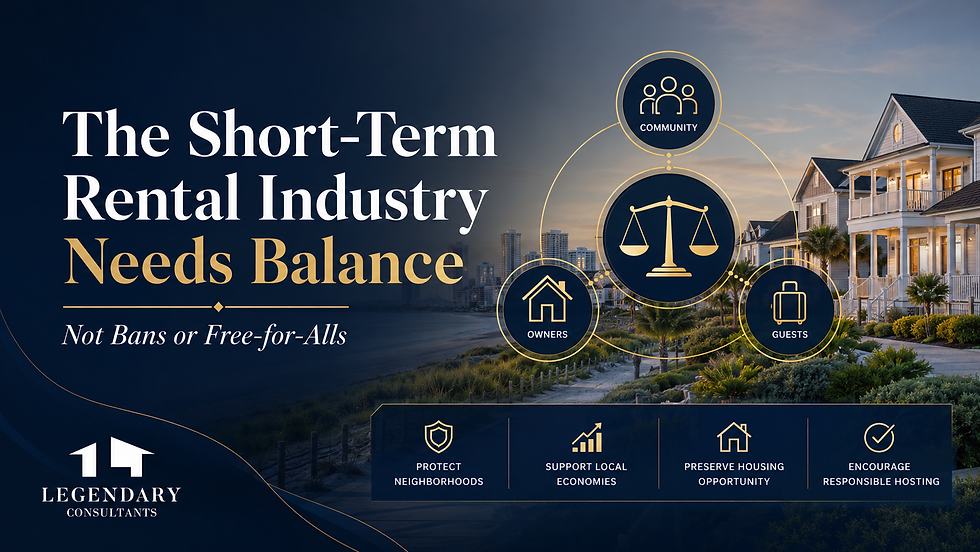
residents, and investors to protect neighborhoods while preserving responsible vacation rental activity.
The short-term rental industry has reached a turning point.
Across the country, cities, HOAs, homeowners, investors, managers, platforms, hotel groups, and residents are all debating the same question:
What should the future of short-term rentals look like?
In some communities, short-term rentals are viewed as an important part of the local economy. They support tourism, help property owners generate income, create work for local vendors, and give families a different type of travel experience than a hotel can provide.
In other communities, they are viewed as a threat to neighborhood stability, housing availability, parking, safety, peace, and quality of life.
The problem is that most of the debate has become too extreme.
On one side, you have the argument that property owners should be allowed to do whatever they want with their homes, wherever they want, with limited or no regulation.
On the other side, you have the argument that short-term rentals should be banned, heavily restricted, or pushed out of residential neighborhoods entirely. That they just do not belong there.
Both sides are right about some things.
Both sides are also wrong about some things.
And that is why the industry needs something more thoughtful than bans or free-for-alls.
It needs balance.
I See This Issue from Multiple Sides
My perspective on this issue is a little different.
I have worked in real estate for more than 20 years as a broker and Realtor, selling homes to both primary homeowners and investors.
I have worked in property management for both long-term residential rentals and short-term vacation rentals.
I have owned rental properties myself, both long-term and short-term.
I have worked with city leaders, served on a planning and zoning board, and seen how difficult it can be for local governments to make decisions when pressure is coming from all sides.
I also live full-time in a tourist market, in a neighborhood near the beach where vacation rentals are not a theory. They are everyday life.
In my neighborhood, the majority of homes are short-term rentals. Some are second homes and weekend homes. An even smaller percentage are full-time residents.
I am one of the full-time residents.
Every home around me is a vacation rental.
And here is the truth:
Many of them are great.
I genuinely enjoy seeing families come and go, watching people experience the island, and knowing that visitors are getting to enjoy a place that I also love.
But some properties create real problems.
Noise.
Parking issues.
Trash problems.
Guests who do not respect the neighborhood.
Repeated police calls.
Homes that seem to attract the wrong type of guest over and over again.
And in my experience, it is usually the same properties creating the same problems repeatedly.
And that is the key point.
The problem is not simply short-term rentals.
The problem is poorly managed, poorly regulated, repeat-problem short-term rentals.
That distinction matters.
The Pro-STR Side Is Right About Some Things
Short-term rental owners and managers are right to be concerned about overregulation.
Many owners purchased homes under one set of rules and built their financial plans around the ability to rent them.
Many managers have built legitimate businesses around responsible vacation rental operations.
Many tourist markets rely heavily on short-term rental guests to support local restaurants, shops, service providers, cleaners, maintenance companies, vendors, and tax revenue.
Short-term rentals can also benefit neighborhoods when they are responsibly operated.
In many tourist communities, vacation rentals help increase property values, bring visitors into the area, and introduce future homeowners to the community. Many people who eventually buy in a destination market first experienced that market as a vacation rental guest.
Short-term rentals can also create revenue opportunities for HOAs when structured properly. Some communities have used guest-based fees or daily per-diem charges to help fund amenities, improve common areas, offset owner dues, and enhance the community for both residents and guests.
When those funds are used responsibly, everyone can benefit.
Guests get better amenities.
Owners get a stronger community.
Residents get improvements without bearing the full financial burden.
Vacation rental owners may see better bookings and stronger rates because the community experience improves.
The community reputation improves.
That is the kind of win-win thinking the industry needs more of.
So yes, the pro-STR side is right about property rights, tourism, economic impact, owner investment, and the value short-term rentals can bring to a community.
But they are wrong when they dismiss every resident concern as exaggeration.
Some concerns are real.
The Anti-STR Side Is Also Right About Some Things
Full-time residents are also right about some things.
A poorly managed short-term rental can absolutely damage quality of life for the people who live nearby and destroy the reputation of the community, and even impact resale values of the community.
When guests are loud late at night, overflow into the street with cars, leave trash out, disrespect neighbors, park and drive on lawns, are publicly drunk and obnoxious, or treat a residential neighborhood like a party zone, the impact is real.
And when the same homes create the same problems repeatedly, residents get frustrated.
And they should.
No one wants to live next to a property that operates like an unregulated event venue.
No one wants to call the police multiple times for the same house.
No one wants their neighborhood to feel like the rules apply to residents but not to weekend guests.
So yes, the anti-STR side is right that bad short-term rentals can create real neighborhood problems.
But they are wrong when they treat every short-term rental owner, guest, and manager as the problem.
They are not.
Many are responsible.
Many are professionally managed.
Many create little or no disruption.
Many bring real value to the community.
That is why blanket bans are often the wrong solution.
STRs are Not the Whole Housing Problem
Short-term rentals are also frequently pulled into the housing affordability debate.
That conversation needs more nuance.
Housing affordability is driven by many factors: supply, zoning, interest rates, construction costs, insurance, property taxes, wages, migration, institutional ownership, investor activity, lending conditions, and local policy.
Short-term rentals are not the whole housing problem.
In many markets, they are not even the primary problem.
But that does not mean they have no impact.
In high-concentration tourist neighborhoods, short-term rentals can affect long-term housing availability, neighborhood stability, and community character.
That is especially true in areas where a large percentage of homes are no longer used as primary residences.
So, the balanced position is this:
Short-term rentals are not the entire housing affordability problem. But in certain high-concentration tourist markets, they can become part of the neighborhood stability problem. They can also impact things like insurance and hoa fees.
That is why regulation should be targeted, thoughtful, and local.
A downtown apartment market in New York City is not the same as a beach community, mountain town, lake market, golf destination, or second-home resort community.
The rules should reflect those differences.
Cities and HOAs Often Get This Wrong
Unfortunately, cities and HOAs often struggle with this issue.
Sometimes the people making the rules are mostly full-time residents who are frustrated with STR problems. In those cases, the reaction may be to ban or heavily restrict vacation rentals without fully considering the impact on owners, property values, tourism, local businesses, or existing investments.
Other times, the people making the rules are mostly STR owners or investors. In those cases, the tendency may be to avoid meaningful restrictions because they fear any new rule will hurt revenue.
And when boards or city leaders are split, they often avoid the issue entirely and hope someone else will deal with it.
That does not solve the problem.
Cities and HOAs need a better framework.
They need rules that protect residents without punishing responsible owners.
They need enforcement that targets repeat problem properties instead of treating every STR the same.
They need to recognize that the issue is not whether short-term rentals should exist.
The real issue is how they should operate.
And the rules and regulations need to be created as close to the STR's and residents as possible. That means responsible HOA's working for ALL of their property owners, not just one side. If HOA's would responsibly and fairly handle the STR industry issues, cities, counties, and states wouldn't have to weigh in or at least not weigh in as heavy. And keeping them out of the industry as much as possible is a win for everyone involved.
Fair Regulation Should Focus on Behavior
Good short-term rental regulation should not be designed to punish responsible operators.
It should be designed to prevent and correct the behaviors that create problems.
That includes things like:
Noise.
Parking.
Trash.
Overcrowding.
Unauthorized parties.
Unverified guests.
Repeat complaints.
Lack of local accountability.
Managers who do not respond.
Owners who ignore problems because the revenue is coming in.
The goal should be simple:
Make it easy for responsible owners and managers to operate and make it difficult for repeat problem properties to continue creating problems.
That is where the win-win exists.
The rules for STR's should be the same for everyone in the community. They should be basic common-sense rules, but they need to be rules with actual consequences when broken. Otherwise, the rules by themselves are worthless.
Simple Rules Can Solve Many of the Problems
Many of the biggest STR problems can be reduced with simple, reasonable, enforceable rules.
For example:
1. Local responsible contact
Every STR should have a responsible local contact available to respond quickly when there is a legitimate issue.
If there is a noise complaint, parking issue, trash problem, or emergency, neighbors and officials should not be stuck trying to reach an out-of-state owner who may or may not answer.
2. Clear occupancy limits
Occupancy should be tied to bedrooms, parking, septic or utility capacity where applicable, and basic safety standards.
A home designed for one family should not be marketed or operated like a small event venue.
3. Parking rules
Parking is one of the most common neighborhood friction points.
Guests should know exactly where they can and cannot park before they arrive. Owners and managers should be accountable when their guests block streets, driveways, beach access points, mailboxes, or neighboring properties.
4. Trash rules
Trash issues are easy to prevent but frustrating when ignored.
Guests should receive clear instructions. Managers should have systems in place. Properties should have proper containers, pickup schedules, and backup plans when guests check out before trash day.
5. Quiet hours and noise standards
Noise rules should be clear, reasonable, and enforceable.
The goal is not to stop people from enjoying their vacation.
The goal is to make sure their vacation does not become a recurring problem for the people who live nearby.
6. Guest verification
Managers and owners should know who is staying in the property.
Basic ID verification, payment source verification, signed rental agreements, and clear guest rules can deter many of the bad actors who create problems.
7. Guest code of conduct
Every guest should agree to basic rules before arrival.
These rules should cover noise, parking, occupancy, trash, parties, pets, smoking, neighborhood respect, and penalties for violations.
These should not be hidden in fine print.
They should be clear.
8. Limits on one-night and same-day bookings
This is one of the most important areas most communities overlook.
Not every one-night or same-day booking is a problem. There can be legitimate exceptions.
But in many markets, a large percentage of problem guests come from last-minute, one-night, poorly screened bookings.
Responsible managers often know this.
Adding reasonable restrictions on same-day and one-night bookings, with specific exceptions, can reduce bad guest behavior without destroying legitimate STR revenue.
It can also help create a healthier balance between STRs and hotels.
Some guests are better suited for hotels, motels, and resorts. Hotels are better equipped for certain last-minute stays, one-night stays, and guests who need on-site staff and immediate service.
Short-term rentals are often better suited for families, groups, longer stays, and guests who want the space, privacy, kitchen, yard, and full-home experience.
That balance matters.
A thriving hotel market and a responsible STR market do not have to be enemies. In many tourist communities, they can support each other when the right rules and expectations are in place.
9. Escalating penalties for repeat violations
The key is enforcement.
A one-time mistake should not be treated the same as a chronic problem property.
But repeated violations should have real consequences.
Warnings may be appropriate at first.
Fines may be appropriate after that.
Suspension or revocation should be available for properties that repeatedly create problems and fail to correct them.
The focus should be on patterns of behavior.
Having STR's register with the HOA in addition to the city, gives HOA's a better view of what is going on in their community.
Having STR owners and managers sign on acknowledging the rules, the community standards, that they are directly responsible for the behavior of their guests, that there are penalties for breaking those rules, and acknowledging that repeated offenses can result in fines, and in them losing the ability to operate STR's in that community should be a standard for all HOA's.
10. Owner and manager accountability
Cities and HOAs cannot rely only on guests to do the right thing.
And unfortunately, cities and HOA's cannot rely on all managers and owners to do the right thing either.
Owners and managers have to be accountable for the systems they put in place, and when they are not, the HOA should hold them accountable.
If a manager accepts risky bookings, fails to screen guests, ignores complaints, avoids basic rules, or refuses to respond when problems happen, that is not just a guest problem.
That is a management problem.
Good Rules Do Not Have to Hurt Responsible Owners
One of the reasons STR owners and managers push back against regulation is fear.
They fear that every new rule will reduce bookings, lower revenue, or lead to a ban.
Sometimes that fear is justified. Poorly written regulations can absolutely harm responsible owners.
But basic operating standards do not have to hurt revenue.
In many cases, they can protect it or even help increase it.
Responsible rules can help:
Reduce guest problems
Improve neighborhood relations
Protect the right to operate
Improve the guest experience
Strengthen community amenities
Reduce political pressure for bans
Create a more stable investment environment
The biggest threat to responsible STR owners is not regulation.
It is irresponsible owners and managers that manage the repeat problem properties that create the public pressure for extreme regulation.
Responsible operators should want bad operators held accountable.
Because when bad operators are ignored, everyone eventually pays the price.
The Same Is True for HOAs
HOAs need to stop treating this as a choice between doing nothing and banning everything.
There is a middle ground.
HOAs can create reasonable guest rules, amenity fees, parking standards, trash requirements, and enforcement processes that apply fairly to both STR's and residents.
They can use guest-based revenue to improve the community instead of simply fighting over whether guests should be allowed.
They can protect full-time residents while still recognizing that STRs may be part of the community’s property value, tourism appeal, and financial structure.
But the key is responsibility.
If an HOA collects fees from STR guests, those funds should be used to enhance the community, offset costs, improve amenities, and benefit both residents and guests.
That is how an HOA turns conflict into alignment.
And setting arbitrary caps on numbers of STR's is not the answer either. That is a knee-jerk reaction to appease the anti-STR side, and not a well thought out, correct solution.
The Win-Win Is Possible
The STR debate does not have to be a fight where one side wins and the other side loses.
A balanced approach can benefit everyone.
Residents get better peace, safety, parking control, trash enforcement, and quality of life.
STR owners get predictable rules and protection from sudden bans.
Managers get professional standards that reward responsible operation.
Cities get tourism revenue, tax revenue, fewer complaints, and less pressure on police and code enforcement.
Guests get clearer expectations and a better experience.
Investors get more certainty before buying.
HOAs get a framework instead of constant political conflict.
Hotels and STRs can serve different guest needs without turning the entire lodging market into a political battlefield.
That is the path forward.
The Industry Needs Responsibility, Not Extremes
The future of short-term rentals should not be built around fear or denial.
It should be built around responsibility, enforcement, and balance.
The pro-STR side needs to acknowledge that bad operators and bad guests create real problems for residents.
The anti-STR side needs to acknowledge that responsible STRs can bring real value to communities.
Cities and HOAs need to stop writing rules based only on whoever is loudest, angriest, or most politically organized.
And the industry itself needs to mature.
Because if responsible owners and managers do not support reasonable standards, they should not be surprised when frustrated residents push for unreasonable restrictions.
And when HOA's ignore the problem or side with just one side or the other in the debate, they should not be surprised with the frustrated residents push back or the cities then get involved.
The best long-term path is not no regulation.
It is fair regulation.
It is regulation that protects neighborhoods without destroying legitimate businesses.
It is regulation that targets behavior instead of ownership.
It is regulation that separates responsible operators from repeat problem properties.
And it is regulation that recognizes a simple truth:
Short-term rentals, when properly managed and fairly regulated, can be a benefit to the communities they operate in.
But they cannot be left entirely to chance.
Not every owner will do the right thing on their own.
Not every manager will protect the neighborhood without clear standards.
Not every HOA will find balance without a framework.
Not every city will get it right without listening to all sides.
That is why this conversation matters.
The short-term rental industry does not need bans or free-for-alls.
It needs balance.
And the communities that figure that out will be the ones that protect residents, support responsible owners, preserve tourism, and create a healthier future for everyone involved.
If you are a short-term rental manager or short-term rental owner and would like to discuss building your business, drop us a line. We'd love to help.
To read more insights on the short-term rental industry, visit our blog page:
Series Note
This article is Part 1 of a three-part series on the future of the short-term rental industry.
Part 2 will look at consolidation in the STR industry and whether vacation rentals are losing the local roots that made them appealing in the first place.
Part 3 will explore how local and regional vacation rental managers can compete with the national giants by becoming more professional, and better utilizing tools and strategy without losing what makes them local.


