Airbnb and Vrbo Are Changing the Rules. But the Real Problem Started Years Ago.
The latest OTA changes are frustrating vacation rental managers. But the larger issue isn't new: Who controls your business, your guest relationships, and your future?
By Mark Spinks | Legendary Consultants October 28, 2026

The Latest Changes Aren't the Problem. They're a Reminder of the Problem.
If you follow the vacation rental industry on LinkedIn, or other online media, you've probably noticed a growing wave of frustration directed toward Airbnb and Vrbo.
New commission structures. More restrictive guest communication rules. Changes to rental agreements. New performance standards. More control over pricing and distribution.
And with each announcement, owners and property managers are asking what the changes mean for their businesses.
I understand their frustration.
But here's something I believe is important to recognize.
This problem didn't begin in October 2026. It's been developing for years.
Throughout my career in real estate and property management, and in the consulting work I do today, I've consistently emphasized the importance of building your own business rather than allowing a third-party platform to become your entire business strategy. You have to maintain control of the tools and marketing of your business if you want your business to truly be yours and grow the way you envisioned.
The vacation rental industry has become increasingly dependent on a handful of enormous companies for something fundamental: access to guests.
And with that dependence comes a significant loss of control.
Many managers now find themselves in a position where their revenue, visibility, guest communication, pricing, and sometimes even their operating procedures are influenced by rules established by companies they don't own and have very little ability to influence.
That's not a healthy long-term business position.
Are you really running your own vacation rental management company, or are you simply operating properties under someone else's business rules?
That is the growing question many managers and owners are asking today.
And while the latest changes are generating plenty of understandable complaints, I think managers need to move beyond reacting to each new announcement.
We need to rethink the entire relationship.
Let's Stop Confusing Distribution Channels With Business Partners
Airbnb and Vrbo are commonly referred to as distribution partners.
But are they really partners in the traditional sense?
A business partner generally shares in your objectives, recognizes the long-term value of your success, and works with you toward mutually beneficial outcomes.
An online travel agency operates a marketplace.
Its primary objective is to attract travelers, generate transactions, grow its business, and create value for its shareholders.
Your primary objective is to grow a profitable vacation rental management company, deliver value to property owners, and establish long-term guest relationships.
Sometimes those objectives align.
Sometimes they don't.
And when they don't, the platform is in control. The platform, in essence, owns the guest relationship. And the platform has the authority to establish the rules governing its marketplace and that protects its objectives - Not yours.
That's the imbalance managers need to understand.
Some frustrated managers describe their relationship with the OTAs as being treated like a necessary evil.
They provide the properties and the operational infrastructure that make the marketplace possible, yet often feel they have less control over the transaction than the platform facilitating it.
Whether that treatment is intentional or simply the consequence of competing business objectives, the practical result is the same.
Managers must adapt to rules they didn't create.
I believe managers need to adopt a different mindset in return.
Stop viewing OTAs as partners whose interests automatically align with yours. Start viewing them as necessary distribution tools that should serve your business strategy - not control it.
Use the platforms for what they do well - generate new traffic and new guests.
But don't build your future around the assumption that they will always do what's best for your company.
Consider the Size of the Businesses We've Helped Build
Here's a comparison that puts the situation into perspective.
As of October 27, 2026, Airbnb had a stock market valuation of approximately $100 billion—roughly comparable to Marriott International and greater than the market valuations of Hilton and Hyatt.
Think about that for a moment.
Airbnb has built one of the most valuable companies in hospitality without owning the vacation rental homes that generate its accommodation bookings.
It operates a global marketplace connecting travelers with properties supplied by hosts and professional managers.
In 2025 alone, Airbnb reported approximately $12.2 billion in revenue.
And where does the underlying accommodation inventory come from?
Property owners.
Who pays to acquire the homes, furnish them, insure them, maintain them, deal with the liability when things go bad, and cover the mortgage and property taxes?
Property owners.
Who handles the housekeeping, maintenance, guest emergencies, property inspections, local issues, and day-to-day operations?
Hosts and professional property managers.
The marketplace provides tremendous value through brand awareness, consumer traffic, booking technology, payment processing, and distribution.
But the underlying properties and much of the operational responsibility belong to someone else.
To be fair, major hotel companies such as Marriott also operate largely asset-light businesses, relying heavily on franchise and management agreements rather than direct hotel ownership.
But that reinforces an important lesson.
One of the most valuable assets in hospitality isn't necessarily the property itself. It's the brand, the customer relationship, and the system that brings travelers back to book again.
Read that again.
This is what they recognize as one of their most valuable business assets, and one of the most important to maintain control over.
One of the most valuable assets in hospitality isn't necessarily the property. It's the brand, the customer relationship, and the systems that bring travelers back to book again.
This is a fundamental part of how some of the world's most valuable hospitality businesses have built their success.
They understand that the value of a guest relationship extends far beyond one reservation.
If these companies recognize the enormous long-term value of building and retaining guest relationships, why aren't more vacation rental management companies making it a central part of their own business strategy?
And that is exactly what vacation rental managers should be thinking about.
Airbnb has built an extraordinarily valuable global brand and booking ecosystem.
Meanwhile, many of the owners and managers who supply the accommodations face rising operating expenses, increasing competition, and pressure on their margins.
Not every property owner or management company is struggling, of course. But the contrast is worth examining.
If the companies distributing your reservations can build businesses worth tens of billions of dollars, shouldn't you be developing a strategy to build greater long-term value in your own company?
Sources: Hospitality company market valuations | Airbnb 2025 Annual Report | Marriott 2025 Annual Report
The Power Has Been Shifting for Years
When Airbnb and Vrbo began gaining widespread adoption, they offered vacation rental owners and managers an extraordinary opportunity.
Suddenly, individual properties could reach enormous audiences without the marketing budgets of major hospitality brands.
They helped bring vacation rentals into the mainstream travel industry.
I don't think anyone should underestimate that contribution.
But as the platforms grew, so did their influence.
Search algorithms evolved. Guest service expectations changed. Cancellation policies became increasingly important to booking conversion. Platform fees and payment systems changed. Communication, guest information, and off-platform booking rules became more consequential.
And here's the reality that many managers find increasingly frustrating.
Airbnb and Vrbo make decisions based on what they believe is best for their marketplaces, their travelers, and their long-term financial performance.
Those decisions may benefit property managers, but that doesn't mean the interests of every individual owner or manager will be protected.
If you disagree with a new policy, your options may be limited.
You can adapt, seek an exception where permitted, or reduce your participation.
But if your company depends on that platform for the majority of its reservations, how realistic is that last option?
The OTA platforms have built businesses that can operate without any one individual property manager. Have you built a business that can operate without any one individual platform?
That's the imbalance we need to address.
Managers found themselves adjusting their procedures, marketing, pricing, and revenue strategies around decisions made by the OTAs, not based on decisions that are necessarily good for their business.
That was happening long before this month's policy announcements.
And in many cases, managers continued increasing their dependence on the very platforms that were gaining more control over their businesses.
Why?
Because the reservations kept coming.
When occupancy is strong and owners are receiving revenue, it's easy to overlook the long-term strategic risks.
But having a full booking calendar is not the same thing as having a strong, independent business.
A company can generate millions of dollars in gross booking revenue and still be vulnerable if nearly all of that business depends on two external platforms.
The latest changes should be viewed in that context.
They are not isolated events.
They are reminders of a longstanding dependence that managers need to address.
And they are not going to be the last changes implemented that owners and managers don't like or agree with.
October 2026: Another Round of Changes
The latest policy developments provide several examples of how this relationship affects day-to-day business decisions.
Airbnb's 15.5% host fee
Airbnb transitioned many software-connected hosts to its single 15.5% host-paid service fee structure, with the latest phase effective October 13, 2026.
The structure combines fees that were previously divided between hosts and guests.
It's important to recognize that this doesn't automatically mean Airbnb increased its total effective fees by 15.5 percentage points. Airbnb provided examples showing how managers could adjust listed prices to preserve guest-facing totals and host payouts.
But managers still had to review their pricing, adjust channel settings, and consider how the changes affected owner revenue and guest price perception.
Vrbo's new commission structure
Vrbo has announced a transition toward a 12% host commission, beginning October 29, 2026, for affected bookings and accounts.
For some software-connected property managers previously paying a 5% commission, that's a substantial increase in the host-side rate.
Guest-facing service fees are also changing, and processing costs can differ depending on who collects payment.
Vrbo has defended the changes as part of improving marketplace competitiveness and reducing guest pricing friction.
Managers, however, must evaluate the financial impact on their individual properties.
And some have received relatively little time to prepare.
Airbnb's updated house rules and guest information requirements
Airbnb has also announced changes effective November 20, 2026, affecting separate rental agreements, guest information requirements, and certain house rules.
The policies contain exceptions, and managers need to evaluate how they apply to their individual properties.
But the changes illustrate another area where an OTA's preferred consumer experience can influence a professional manager's established operating procedures.
The details of each change matter.
Some may benefit travelers. Some may improve booking conversion. Others may create legitimate operational or financial challenges for managers.
But I think the most important lesson goes beyond debating whether any particular policy is fair. And one thing is clear. OTA changes are designed to benefit the OTA and the traveler, NOT the owner or manager.
If your business depends heavily on a third party, that third party has considerable influence over how you operate.
And that influence can change with very little warning.
The Real Prize Isn't the Reservation. It's the Guest Relationship.
This is where I believe vacation rental managers need the biggest change in perspective.
Airbnb and Vrbo aren't merely interested in generating this year's bookings.
They want travelers to continue returning to their marketplaces for future reservations.
They view the guests and travelers as THEIR guests and travelers, NOT yours. That is apparent in the policies. You need to change that.
That recurring customer relationship is tremendously valuable.
Think about the typical vacation rental transaction.
A guest searches Airbnb, discovers your property, books a stay, and arrives for vacation.
Your company provides the clean home, smooth check-in, local recommendations, responsive communication, and positive guest experience.
The guest checks out, leaves a wonderful review, and begins thinking about the next vacation.
Where do they go when they're ready to travel again?
For many guests, the answer is Airbnb or Vrbo.
Not the management company that delivered the experience.
And that's a missed opportunity.
The platform helped acquire the original reservation. Your team delivered the hospitality and the experience.
Yet the traveler may primarily remember the platform's brand.
And whose fault is that? Whose responsibility is it to make sure the traveler remembers the name of your company and shouts it from the rooftops?
The OTA gets another opportunity to earn a booking. Your company may have to compete all over again for a guest you've already served.
How many of you have had a repeat guest that booked using the same OTA as before? They obviously loved your place and your hospitality and care. But didn't come to you directly to book.
This is one reason the platforms place restrictions on moving transactions off-platform and, in Airbnb's case, on using platform-provided guest information for future booking solicitation.
There are valid consumer protection and privacy considerations behind these policies.
But the restrictions also illustrate how carefully the platforms manage the guest relationship.
Professional managers must respect those policies, guest privacy, and applicable marketing-consent requirements.
The solution isn't to circumvent the rules.
It's to develop legitimate, independent opportunities for travelers to discover, recognize, trust, and engage with your company.
The Guests May Be More Open to Direct Booking Than You Think
And here's something vacation rental managers should find encouraging: research suggests many travelers are open to alternatives to the major booking platforms. Booking.com's 2025 Travel & Sustainability Report found that 73% of travelers want their travel spending to benefit local communities. A separate 2026 survey by The Guestbook of 3,342 travelers within its loyalty community found that 86% had either booked a vacation rental directly or would consider doing so.
Primary sources: Booking.com 2025 research · The Guestbook 2026 survey
What would make them comfortable? Clear cancellation policies (70%), secure payment processing (63%), and verified guest reviews (60%). While these findings don't mean travelers are abandoning Airbnb and Vrbo - and The Guestbook's results aren't representative of all travelers - they do challenge the idea that guests will only book through a major OTA.
Travelers want value, convenience, security, and trust. Many also care about where their travel dollars go and whether those dollars benefit the communities they visit.
For independent vacation rental managers, that represents an opportunity to build their own marketing authority, establish credibility, deliver exceptional guest experiences, and give travelers compelling reasons to book directly. The demand for alternatives may be there. The responsibility for earning those reservations belongs to us.
Stop Viewing OTAs as Your Primary Booking Source
Here's a change in thinking that I've encouraged for years and that sits at the center of my Full Spectrum Approach.
Stop viewing OTAs simply as your primary booking source. Start viewing them as a potential introduction to guests for life.
The OTA may deliver the first reservation.
But the experience you provide is an opportunity to build your own brand reputation and give travelers a reason to recognize your business.
That doesn't guarantee a direct booking in the future, and it doesn't override the OTA's communication or marketing restrictions.
It does reinforce the importance of building independent demand and permission-based guest relationships outside the platform.
I summarize the philosophy this way:
Let the OTA Deliver the First Booking. Build the Next One.
You should be asking what happens beyond that first transaction.
Do guests remember your company's name?
Can they easily discover your website independently?
Does your website provide useful content about the destination?
Are you building a legitimate, consent-based audience through your own marketing channels?
Do you have systems for encouraging repeat business among guests you can lawfully market to?
Do you provide a guest experience memorable enough to generate referrals?
Those are the questions that help determine whether your company is building its own long-term business value.
Look at What the Major Hotel Brands Have Been Doing for Decades
There's another lesson vacation rental managers can take from companies like Marriott and Hilton.
They don't simply rely on third-party booking platforms to deliver guests.
They have invested heavily in recognizable brands, direct-booking experiences, loyalty programs, customer databases, repeat-business campaigns, and relationships with travelers.
They understand that the guest relationship has value far beyond one reservation.
A hotel guest may initially discover a property through a third-party channel, but the hotel brand also has independent ways to attract and retain customers.
Vacation rental management companies can apply the same general philosophy on a scale appropriate to their businesses.
You don't need Marriott's marketing budget.
You need a deliberate strategy for building your own brand, attracting the right travelers, generating direct demand, and maintaining meaningful guest relationships.
And that's where the Full Spectrum Approach comes into play.
Building a Business That Can Stand on Its Own
A strong OTA strategy isn't simply about increasing the percentage of direct reservations.
It's about improving the underlying strength of the company.
That requires several connected efforts.
Build marketing authority.
Your website should attract travelers researching your destination, not merely serve as another place to display available properties.
Develop content around the reasons people travel to your market.
Golf. Beaches. Sporting events. Family vacations. Winter visitors. Hiking. Fishing. Local festivals.
Become a trusted source of destination information.
Give people a reason to discover your company before they begin comparing individual properties.
Develop the Guest Engine.
Create systems for building an independent, permission-based guest audience.
Use appropriate guest communications, useful travel content, repeat-booking opportunities, referrals, and loyalty initiatives to build relationships over time.
Treat guest information as a strategic asset that must be acquired and managed responsibly.
Make the guest want to be connected to you. Give them a reason to connect.
Connect revenue and channel strategy.
Understand what each reservation truly contributes after distribution and acquisition costs.
Look at booking windows, cancellation exposure, channel commissions, pricing differences, and the costs of generating direct reservations.
Don't focus exclusively on occupancy and average nightly rates.
Consider the long-term economics of the business.
Strengthen owner relationships.
Explain your strategy to property owners.
Show them that you're not simply listing their homes on Airbnb and Vrbo and waiting for reservations.
Demonstrate how you generate demand, position properties, manage revenue, develop repeat business, and reduce distribution risks over time.
A manager who can clearly communicate these strategies has a compelling differentiator when competing for new owners.
Use technology to connect the pieces.
Your property management system, revenue tools, website, CRM, email marketing, guest database, and reporting platforms should work toward the same business goals.
Technology should support your strategy rather than dictate it.
Software is not the strategy. The strategy is how everything works together.
What Happens If Your Largest Booking Source Changes Tomorrow?
Here's a question I think every vacation rental management company should consider.
What if your largest OTA suddenly reduced your visibility, changed its terms, or became substantially less effective at generating reservations?
Would you still have a meaningful source of independent demand?
Would your brand attract travelers through organic search?
Would past direct guests return?
Would referrals and destination content generate inquiries?
Would your website convert the visitors you attract?
Would owners understand why your management company offers something more than simply listing their homes on major travel platforms?
You don't have to eliminate OTA dependence overnight.
But you should have a realistic plan to reduce unnecessary exposure.
A company that generates most of its revenue through a single channel has a concentration risk, even if bookings are currently strong.
Diversification won't eliminate risk, but it can improve resilience and give you more options when marketplace conditions change.
One lesson I've learned throughout decades of running businesses is that markets will always change. Economic conditions shift. Technology evolves. Consumer behavior changes. New competitors emerge.
You cannot control everything that happens around your business.
But you can control how prepared your business is to respond.
When you've developed your own marketing authority, established guest relationships, diversified revenue sources, and built efficient operating systems, you have more options when conditions change.
When your business depends almost entirely on decisions made by someone else, those options become much more limited.
I've seen businesses struggle through changing markets not necessarily because they were poorly managed, but because they hadn't developed the flexibility or independent demand necessary to adapt.
The goal isn't to eliminate uncertainty. It's to build a company strong enough to navigate it.
This Is Bigger Than Airbnb and Vrbo
The lesson isn't limited to the vacation rental industry.
Businesses in many industries have learned what happens when they become dependent on third-party marketplaces, search engines, social media platforms, and other intermediaries.
Those platforms can provide enormous opportunities for growth.
But they can also change the rules.
The businesses that endure are often those that use outside platforms strategically while investing in assets and relationships they can control.
For vacation rental managers, those assets include their brand, website, destination content, owner relationships, operational reputation, direct-booking capabilities, and independently developed guest audience.
Those are the things that create lasting enterprise value.
And they are precisely the areas the Full Spectrum Approach™ is designed to connect.
The Full Spectrum Approach™: Building the Business Behind the Bookings
OTA dependence isn't just a booking problem.
It's connected to virtually every major function of a vacation rental management business.
Revenue Strategy determines how bookings translate into financial performance.
Marketing Authority helps create independent demand.
Direct & Repeat Booking Strategy builds a healthier distribution mix.
Operational Trust strengthens guest satisfaction, owner confidence, and reputation.
Owner Acquisition & Retention turns demonstrated performance into sustainable portfolio growth.
Technology & Systems Strategy makes the business more connected, efficient, and measurable.
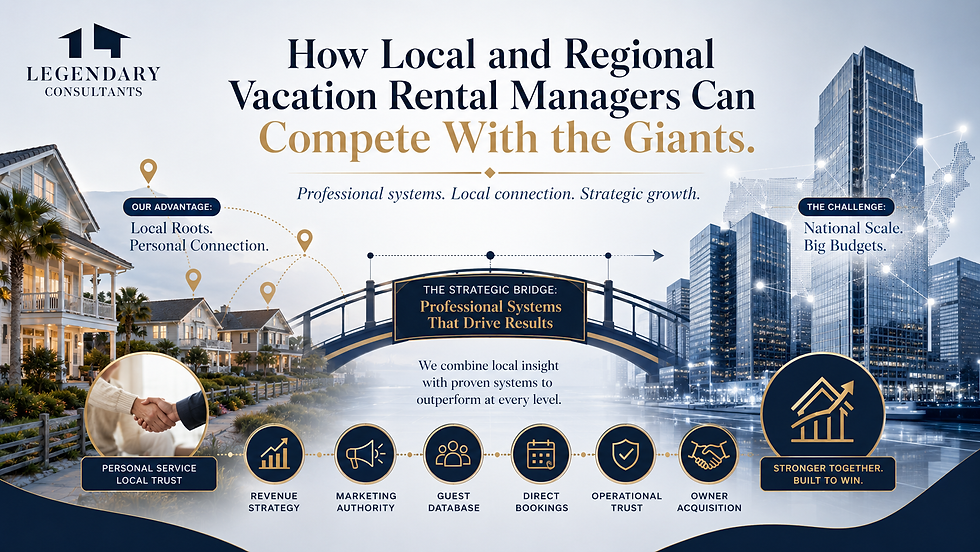
And The Guest Engine helps turn guest experiences and relationships into opportunities for future business.
None of these functions operates in isolation.
The real opportunity is understanding how they strengthen one another.
That's the philosophy behind the Full Spectrum Approach™, and it's a strategy I've been developing and applying through years of working in real estate and property management.
The latest OTA changes don't invalidate the value of the platforms.
They reinforce why managers need a strategy that extends beyond them.
Stop Complaining About the Rules. Start Building a Business Less Dependent on Them.
I understand why managers are frustrated.
They've invested in properties, built teams, served guests, and helped grow the industry into what it is today.
Then another policy changes.
Another fee increases.
Another procedure needs to be revised.
And it can feel as though the companies benefiting from their work have increasing control over their operations.
But here's the reality.
Airbnb and Vrbo aren't going to stop pursuing their own business objectives simply because those objectives conflict with yours.
And you shouldn't expect them to.
Their job is to build their business. Your job is to build yours.
Use their technology. Use their distribution. Use the tremendous consumer awareness they've created.
But recognize the relationship for what it is.
They are channels through which you acquire reservations, not substitutes for your own marketing strategy, customer relationships, or business development.
For many managers, OTAs are a necessary part of doing business.
That doesn't mean they have to be the foundation of the entire company.
The goal isn't to fight the platforms.
The goal is to become less dependent on them.
Let the OTAs help you generate today's reservations. But build your own brand, guest relationships, and demand to help secure tomorrow's business.
That's the difference between managing properties and building a sustainable vacation rental management company.
How Dependent Is Your Business on Airbnb and Vrbo?
The Full Spectrum Property Manager Scorecard™ helps evaluate how well your revenue strategy, marketing, owner acquisition, operations, technology, and guest relationships work together.
Identify the strengths of your business, discover potential vulnerabilities, and determine where improvements could create the greatest impact.
[Take the Full Spectrum Property Manager Scorecard]
You can also read our foundational article, [The Full Spectrum Approach: Why Vacation Rental Growth Requires More Than Pricing Software, Marketing, or More Properties], to explore the complete seven-part framework.
Let's Talk About Your Business
Every vacation rental management company is different. Your portfolio, market, guest demographics, and business goals all influence which strategies will make the greatest difference.
If you're concerned about OTA dependence, struggling to generate direct bookings, or simply wondering whether the different parts of your business are working together as effectively as they could, let's have a conversation.
We can discuss your current approach, identify potential opportunities, and explore practical ways to build a stronger, more independent vacation rental management business.
Mark Spinks - Founder | Legendary RE Consultants
Editor's note: Market capitalizations cited above reflect October 27, 2026 estimates and change with stock prices. Platform policy details reflect announcements available as of October 28, 2026. Individual contracts, regions, and exceptions may affect how specific changes apply.