Not All Vacation Rental Owners Are Created Equal
Updated: Apr 1
Why Your Portfolio Composition Matters More Than You Think

Most vacation rental managers focus on growing their portfolio.
More properties.
More listings.
More doors.
But there’s a problem with that approach.
Not all properties—and more importantly, not all owners—are created equal.
The type of owners in your portfolio will ultimately determine your ability to:
scale
generate revenue
build a sustainable business
And yet, most managers never stop to evaluate this.
They simply grow.
The Hidden Variable Behind Portfolio Growth
In the early stages, growth often feels straightforward.
You bring on new properties.
You increase bookings.
Revenue grows.
But over time, something changes.
Growth slows.
Operations become more complex.
Revenue becomes inconsistent.
At that point, many managers assume the issue is:
marketing
pricing
competition
But often, the real issue is something far less obvious:
Portfolio composition.
The Two Types of Vacation Rental Owners

At a high level, most owners fall into one of two categories.
Understanding the difference is critical.
1. The Investor-Minded Owner
This owner views their property as a business.
Their primary focus is:
maximizing revenue
optimizing performance
generating return on investment
They tend to:
allow flexible booking calendars
trust data-driven pricing strategies
invest in upgrades and improvements
prioritize performance over personal use
These owners are aligned with growth.
They scale with you.
2. The Lifestyle Owner
This owner views their property as a personal asset.
Their focus is different:
personal use
emotional attachment
covering costs
They often:
block peak revenue dates
resist pricing or operational changes
prioritize personal convenience over performance
make decisions more slowly
These owners are not wrong—they simply have different goals.
But from a business perspective:
They limit scalability.
The Core Problem Most Managers Overlook
Most vacation rental managers treat these two owner types the same.
Same messaging.
Same expectations.
Same contract structure.
That creates friction.
Because:
Different goals require different strategies.
And when those differences are ignored, the result is:
inconsistent performance
operational inefficiency
stalled growth
Should You Take Both Types of Owners?
The answer is not as simple as yes or no.
It’s strategic.
Option 1: Investor-Focused Portfolio
This is the most scalable model.
stronger revenue performance
better alignment with pricing strategy
easier operational execution
These portfolios are built for growth.
Option 2: Mixed Portfolio
This is the most common model.
But it requires:
clear segmentation
different expectations
structured communication
Without that structure, it becomes chaotic.
Option 3: Lifestyle-Focused Portfolio
This model can work—but it has limits.
lower revenue ceiling
slower growth
more operational friction
It’s a different business—not a scalable one.
The Strategic Shift: Designing Your Portfolio
Most managers don’t design their portfolio.
They inherit it.
They accept properties based on availability, not alignment.
But high-performing companies take a different approach.
They ask:
“Does this property—and this owner—fit the business we are trying to build?”
This is where strategy replaces reaction.
Should Owner Types Have Different Terms?
This is where most managers hesitate.
But the answer is clear:
Yes.
Because:
Different owner behavior creates different business value.
An owner who:
blocks peak dates
limits pricing flexibility
prioritizes personal use
is fundamentally different from one who:
optimizes for revenue
supports strategic decisions
enables performance growth
Treating them the same creates imbalance.
What This Can Look Like in Practice
For investor-minded owners:
standard management structure
performance-based optimization
aligned incentives
For lifestyle owners:
higher management rates
structured usage terms
adjusted performance expectations
This is not about penalizing owners.
It’s about aligning your business model with reality.
The Bigger Insight
Most managers believe:
“More properties = more growth”
But the reality is:
“Better aligned properties = scalable growth”
The wrong mix of owners will cap your performance—no matter how strong your marketing or pricing strategy is.
How This Connects to the Full Spectrum Approach
Portfolio composition directly impacts every part of your growth system.
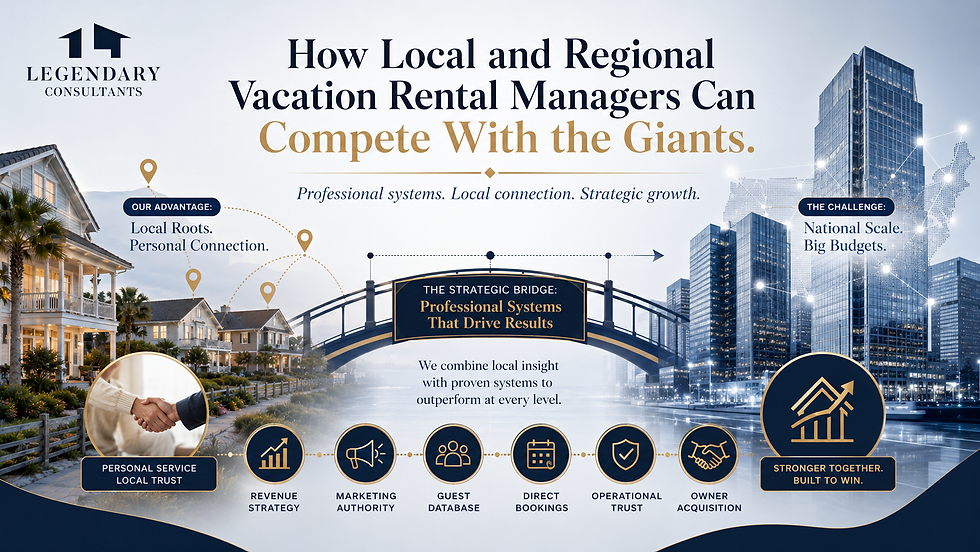
Revenue Strategy Investor-aligned properties allow true optimization.
Marketing Authority Stronger performance builds credibility.
Operational Trust Clear expectations reduce friction.
Owner Acquisition You begin attracting the right type of owners.
When these elements align, growth becomes predictable.
Key Takeaways for Vacation Rental Managers
Not all owners have the same goals
Portfolio composition directly impacts scalability
Treating all owners the same creates inefficiency
Investor-aligned owners drive growth
Strategic managers design their portfolio—not just grow it
Final Thought
The next phase of growth in the vacation rental industry will not be defined by:
better tools
more listings
increased automation
It will be defined by:
better decisions.
And one of the most important decisions you can make is this:
What kind of owners do you want in your portfolio?
Because ultimately:
The owners you choose determine the business you build.
Legendary Consultants can Help You Build a Portfolio Designed for Growth, Schedule a Strategy Consultation