
How to Reduce OTA Dependence Over Time (Without Losing Bookings)
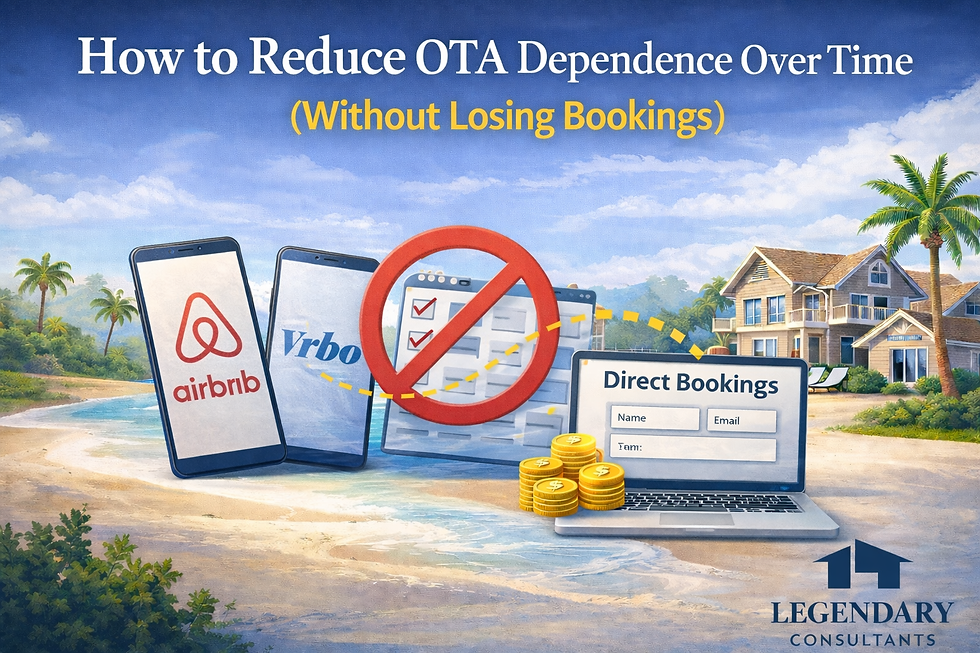
Most vacation rental managers rely heavily on Airbnb and Vrbo.
And early on, that makes sense.
These platforms provide:
Immediate visibility
Consistent booking volume
Access to large audiences
But over time, heavy reliance on OTAs creates challenges:
High fees
Limited control
No ownership of guest relationships
The goal isn’t to eliminate OTAs
It’s to reduce dependence on them strategically
Why Reducing OTA Dependence Matters
Relying too heavily on Airbnb and Vrbo creates a ceiling on your growth.
It limits:
Profit margins
Brand control
Long-term scalability
Every booking that stays on platform is a missed opportunity to build your own system
The Mistake Most Managers Make
Many managers try to:
“Replace OTAs”
This usually fails.
Why?
Because OTAs are:
Powerful demand aggregators
Trusted by travelers
Difficult to compete with directly
The goal is NOT replacement
It’s rebalancing your booking mix over time
The Right Strategy — Shift, Don’t Replace
Instead of removing OTAs:
Use them as a top-of-funnel acquisition channel
Then:
Build systems that capture and convert that demand into long term repeat guests and future direct bookings
Step 1 — Maximize OTA Performance First
Before reducing dependence:
You need strong OTA performance
Why?
Because:
More bookings = more guest data
More guests = more future opportunities
This connects directly to: Optimize Airbnb and Vrbo Performance
Step 2 — Turn OTA Guests Into Repeat Guests
This is the leverage point.
Every OTA booking should be viewed as:
A life-long repeat guest, and future direct booking opportunity
Build systems to:
Stay connected
Deliver strong experiences
Encourage return visits
This is where dependence starts to decrease
Step 3 — Build Direct Traffic Channels
To reduce reliance on OTAs, you need your own demand sources.
Key channels:
SEO (content + blogs)
Email marketing
Social media
Repeat guests
Brand awareness
This is where your Direct Booking Strategy comes in
Step 4 — Create a Direct Booking Path
It’s not enough to have traffic—you need conversion.
Make it easy for guests to:
Find your website
Connect to your social media
Sign up for newsletters and promotions
Understand your brand
Book directly
Your website should function as a conversion system
Step 5 — Gradually Shift Your Booking Mix
This is not immediate.
Over time, you want to move from:
90% OTA / 10% direct
To:
60% OTA / 40% direct
Then 50/50
Or better
This increases margins and control
Why This Strategy Works
This approach:
Maintains booking volume
Reduces risk
Improves margins
Builds long-term sustainability
You’re not removing demand—you’re redirecting it
This Is Part of a Larger Growth System
Reducing OTA dependence is not a standalone tactic.
It connects to:
Marketing
Revenue strategy
Guest experience
Brand positioning
This is part of the Full Spectrum Approach
Build a Growth Strategy That Works
If you want to reduce OTA dependence while increasing revenue and control:


